Kilimanjaro in Luxury: White Mountain Camp and the Lemosho Route, Day by Day
A luxury Kilimanjaro climb with a private camp, camp chef and 24/7 mountain doctor. The Lemosho Route day by day, and open departures in February and July 2027.
Kilimanjaro is a climb people carry for the rest of their lives. The summit is the same for everyone who reaches it. What changes is everything around it: how you sleep, what you eat, who is watching your health, and whether the week feels like an ordeal or a passage. White Mountain Camp is built on that second idea, and it is why we now refer travellers to it, by application. Who Built It White Mountain Camp was conceived by Swiss mountaineer Janosch Amstutz. The camp pairs disciplined expedition craft with an almost editorial eye for detail: an elegant private camp set against volcanic wilderness, considered food at altitude, and a pace built around both performance and presence. Its own phrase for the idea is raw altitude, refined execution. It is also explicit about who it is not for: this is not the crowded Kilimanjaro of checklists and headlamps. What Is Different on the Mountain What the camp carries, as White Mountain Camp describes it The camp. Arctic expedition tents made with HEIMPLANET, built for the most demanding environments, set up as a private camp. The beds. Elevated trail beds with proper linens and Swiss down duvets, in single, twin or double. The food. A private camp chef cooking western and local dishes at altitude, with fresh, locally sourced ingredients alongside international ones. The doctor. A dedicated mountain doctor on hand 24/7, with a medical check every day. The comforts. Real hot showers and private, gender-separated camp toilets. Both ends. Private transfers to and from Kilimanjaro International Airport, and a night at a five-star boutique lodge before the climb and after it. Of all of these, the doctor matters most. On Kilimanjaro your health is the biggest single factor in reaching the summit, and a daily check from someone whose only job is your health is the most useful thing a camp can add. The beds and the showers are what make the week comfortable; the doctor is what keeps it safe. The Lemosho Route, Day by Day The Lemosho Route is widely considered the most beautiful approach on Kilimanjaro, with sweeping views, a strong acclimatisation profile and one of the highest summit success rates on the mountain. Days run six to eight hours on foot, roughly 8 to 15 kilometres, at a steady pace that lets the body adjust. The landscape changes as you climb: rainforest with colobus monkeys, then open moorland and volcanic plateau, then the alpine desert below the last equatorial glaciers in Africa. Climb high, sleep low: the altitudes White Mountain Camp publishes for the route Arrival. You land at Kilimanjaro International Airport and are driven to a five-star lodge in a nearby wildlife reserve. That evening you meet your lead guide, go through the days ahead and check every piece of equipment, with time to arrange anything missing before the climb. Days one to three. After breakfast on day one you drive to the forested slopes, sort permits at Lemosho Gate and walk into cool rainforest to Big Tree Camp, a quiet cle
Kilimanjaro is a climb people carry for the rest of their lives. The summit is the same for everyone who reaches it. What changes is everything around it: how you sleep, what you eat, who is watching your health, and whether the week feels like an ordeal or a passage. White Mountain Camp is built on that second idea, and it is why we now refer travellers to it, by application.
Who Built It
White Mountain Camp was conceived by Swiss mountaineer Janosch Amstutz. The camp pairs disciplined expedition craft with an almost editorial eye for detail: an elegant private camp set against volcanic wilderness, considered food at altitude, and a pace built around both performance and presence. Its own phrase for the idea is raw altitude, refined execution. It is also explicit about who it is not for: this is not the crowded Kilimanjaro of checklists and headlamps.
What Is Different on the Mountain
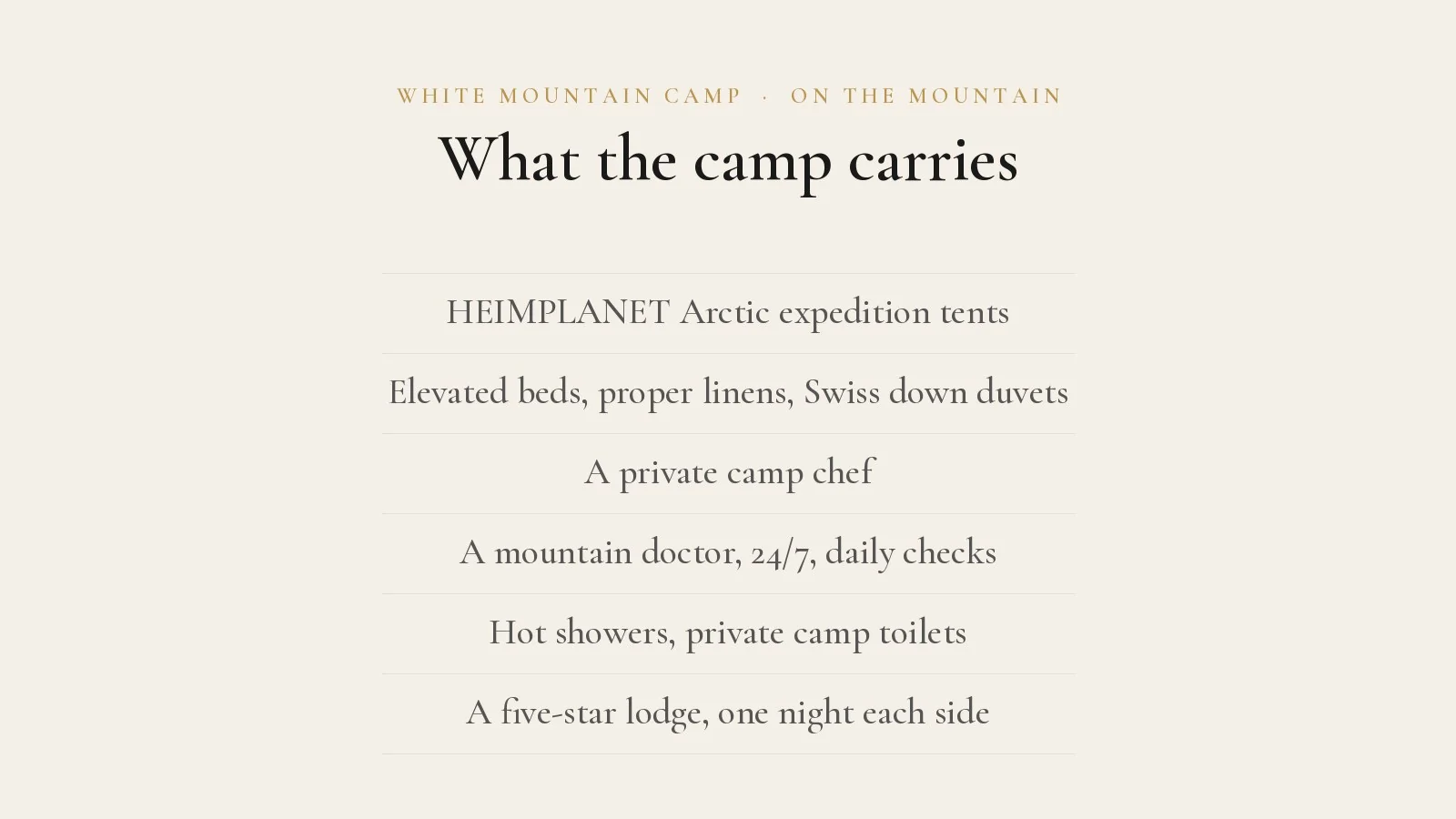
The camp. Arctic expedition tents made with HEIMPLANET, built for the most demanding environments, set up as a private camp.. The beds. Elevated trail beds with proper linens and Swiss down duvets, in single, twin or double.. The food. A private camp chef cooking western and local dishes at altitude, with fresh, locally sourced ingredients alongside international ones.. The doctor. A dedicated mountain doctor on hand 24/7, with a medical check every day.. The comforts. Real hot showers and private, gender-separated camp toilets.. Both ends. Private transfers to and from Kilimanjaro International Airport, and a night at a five-star boutique lodge before the climb and after it.
Of all of these, the doctor matters most. On Kilimanjaro your health is the biggest single factor in reaching the summit, and a daily check from someone whose only job is your health is the most useful thing a camp can add. The beds and the showers are what make the week comfortable; the doctor is what keeps it safe.
The Lemosho Route, Day by Day
The Lemosho Route is widely considered the most beautiful approach on Kilimanjaro, with sweeping views, a strong acclimatisation profile and one of the highest summit success rates on the mountain. Days run six to eight hours on foot, roughly 8 to 15 kilometres, at a steady pace that lets the body adjust. The landscape changes as you climb: rainforest with colobus monkeys, then open moorland and volcanic plateau, then the alpine desert below the last equatorial glaciers in Africa.
Arrival. You land at Kilimanjaro International Airport and are driven to a five-star lodge in a nearby wildlife reserve. That evening you meet your lead guide, go through the days ahead and check every piece of equipment, with time to arrange anything missing before the climb.
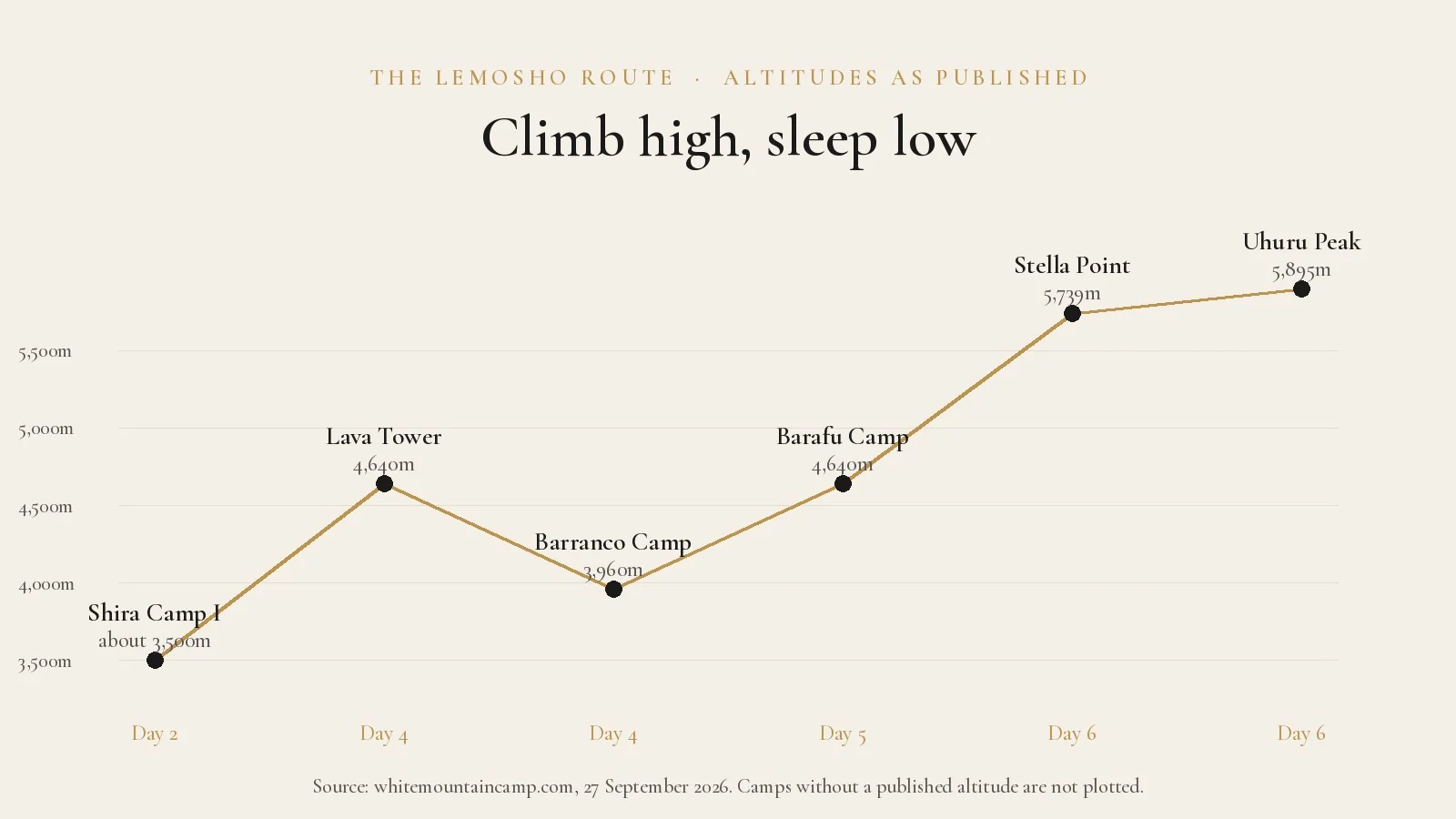
Days one to three. After breakfast on day one you drive to the forested slopes, sort permits at Lemosho Gate and walk into cool rainforest to Big Tree Camp, a quiet clearing under ancient trees. Day two climbs out of the forest into heather and moorland, over the Shira Ridge onto the Shira Plateau, one of the highest plateaus on earth, to Shira Camp I at around 3,500m, where Kibo comes fully into view. Day three crosses the plateau toward the Northern Ice Fields to Shira Camp II, with an acclimatisation walk higher before you return to rest.
Day four is the one that shapes the week. The vegetation falls away into high-altitude desert, across old lava ridges beneath the glaciers of the Western Breach, to lunch at Lava Tower, 4,640m. The afternoon drops into the Great Barranco Valley and its giant senecios, to sleep at Barranco Camp, 3,960m. Climbing high and sleeping lower is what helps the body adapt.
Day five starts with the Barranco Wall, a dramatic but manageable scramble with hands on rock, rising beneath the Heim and Kersten glaciers. Beyond Karanga it is scree, sky and volcanic stone to Barafu Camp at 4,640m, below the summit slopes. The rest of the day is for water, food and sleep.
Day six is summit day. You wake near midnight to hot tea and climb slowly by headlamp over the scree. Dawn arrives at Stella Point, 5,739m, with the glaciers glowing and Mawenzi in the distance, and a final push brings you to Uhuru Peak, 5,895m or 19,341ft, the highest point in Africa. After time at the top you descend through Barafu to Millennium Camp. Day seven walks down through the forest to Mweka Gate and back to the lodge for a long shower, a proper rest and summit certificates at dinner.
Who It Suits
This is a real climb. Six days in a row of six to eight hours on foot, a scramble on day five and a summit push that starts near midnight above 4,600m. The camp makes the week comfortable; it does not make it short. It suits people who already hike multi-day routes, who want to stand on the highest point in Africa, and who would rather spend their energy on the mountain than on a cold tent. If you are new to trekking, build a base first and tell us where you are when you apply. We would rather match you to the right departure than put you on the wrong one.
It also suits leadership teams. White Mountain Camp runs private ascents built around a group, with the same camp, private guiding and medical standards as the scheduled climbs: seven days of shared challenge in real conditions, as a deliberate alternative to a conventional offsite.
Dates, Pricing and How to Apply
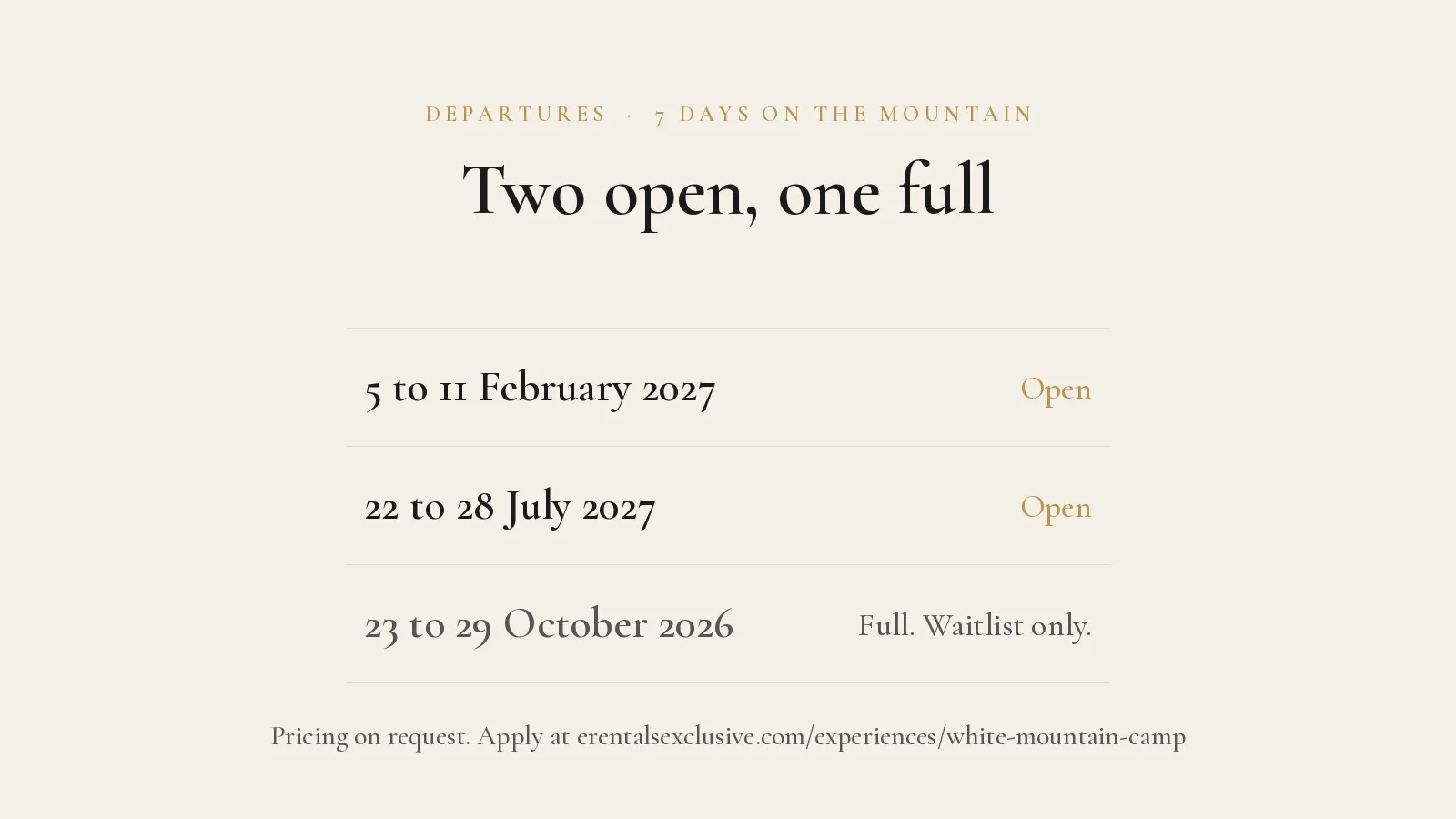
5 to 11 February 2027: open. 22 to 28 July 2027: open. 23 to 29 October 2026: full, waitlist only
Pricing is on request, in single, double or twin occupancy, and we send the full terms with our reply to your application. Half is paid on booking and the balance 60 days before the trip. The climb includes all ground transfers, airport pick-up and drop-off at JRO, national park fees and permits, all meals on the mountain, tents and mountain equipment, and the lodge with half board for a night on each side. It excludes flights, visas, travel insurance and gratuities for the local guides and porters. Dates and inclusions are the host's own,