The operator guide to luxury villa rentals in France. Cote d'Azur, Provence, Paris, and the French Alps: neighborhoods, timing, chef service, direct booking.
Discover Luxury
Curated collection of exclusive villas, yachts, and premium transport
One country, four completely different luxury villa markets, and the operating manual for each.
France is the only country on the ERentals roster where a single booking word covers four distinct luxury villa markets that share nothing except a passport. The Cote d'Azur cap-corridor from Saint-Tropez through Cap-Ferrat is one economy: coastal estates, deep-water moorings, a beach-club season indexed to the yacht calendar and the event weekends. Provence, one hour inland from the same coast, is a different country: dry-stone bastides in the Luberon, Cezanne's landscape around Aix, chef-driven markets that run on the vegetable rather than the fish. Paris is a fourth-arrondissement conversation entirely: hotel-particulier and top-floor apartment stock in the sixth, seventh, and eighth, where the villa word means private residence with staff rather than a house with a pool.
And the French Alps are a winter product with their own architecture, their own airport (Geneva), and their own operating manual: chalets in Chamonix, Megeve, Courchevel, and Val d'Isere that only fully make sense between December and April. Villa outperforms hotel here for reasons that vary by region. On the Cote d'Azur, the top-tier hotel stock (the Hotel du Cap-Eden-Roc, the Grand-Hotel du Cap-Ferrat, the Cheval Blanc Saint-Tropez) runs 2,500 to 6,000 euros a room in season and books out for Cannes and the Grand Prix twelve months out, so a group of eight to fourteen lands more privacy and a lower per-bed spend in a Ramatuelle estate. In Provence, the household-with-chef model is native to the region rather than a hotel retrofit, and a mas with a resident cook running the Sunday market at Coustellet delivers a trip the hotels cannot copy.
In Paris, a full-floor apartment on Rue de Grenelle with a staffed kitchen removes the two friction points every hotel imposes (restaurant reservations at breakfast, elevator queues at check-out). In the Alps, the chalet is the whole point: a boot room, a ski concierge, a chef who plates raclette at 8pm after the last lift. Understanding which France you are booking is the whole exercise.
When to visit France
Peak season on the Cote d'Azur runs mid-May through mid-September, driven by weather and the event calendar. Daytime highs sit at 78 to 86 Fahrenheit (26 to 30 Celsius) with the Mediterranean at 72 to 76 (22 to 24) by August, and the coast operates at full capacity. July and August are the family-and-yacht window; June and September are the shoulder that repeat travelers prefer, warm enough for the water and thinner on the coastal N98 between Saint-Tropez and Cannes, which gridlocks nightly by 6pm in high summer. October runs into the 70s Fahrenheit (21 to 23 Celsius) and mostly dry, still swimmable in the first two weeks, priced 30 to 40 percent below August. November through March the coast empties, restaurants pull hours, and pricing drops another 20 to 30 percent, but a Provence-based winter week with the fireplace lit and truffle season on the market runs beautifully at a fraction of summer rate.
Three events reshape Riviera pricing more than the weather does. The Cannes Film Festival, running roughly twelve days in mid-May, sends premium villa rates in Cannes, Mougins, Mouans-Sartoux, and along the Croisette corridor two to three times above the June baseline, with seven-night minimums and the strongest inventory booked twelve months ahead. The Monaco Grand Prix, the last weekend of May, is the second spike, concentrated in Monaco, Cap d'Ail, Beaulieu-sur-Mer, and Cap-Ferrat: three-to-four-day minimums, premium villas within 20 minutes of the circuit clearing at 3,000 to 8,000 euros a night, harbor-view apartments with balconies onto the track holding their own market entirely. The Cannes Lions creative festival in mid-June and the Nice Jazz Festival in mid-July add secondary demand that shows up as elevated rates but not the seven-night lockouts of the major two. The Tour de France passes through different French regions each July on a rotating course, and a mountain-stage weekend in the Alps or the Pyrenees turns an ordinary week into a five-night minimum in the affected valley.
Provence and Paris run different calendars. Provence peaks with the Cote d'Azur through July and August but stretches longer, from late April lavender through October harvest, and the shoulder May and September months are consistently the strongest weather-plus-quiet combination in the country. Paris has almost no true off-season: the fashion weeks (late February and late September for women's, mid-January and late June for men's) each pull premium apartment rates 40 to 60 percent above baseline, Roland-Garros the last week of May and first of June does the same for the sixteenth arrondissement and Auteuil, and Christmas week compresses everything. August in Paris is the true quiet: locals leave, restaurants shutter for two to three weeks, and the museums stay open for the tourists who fill the gap.
The French Alps run on the ski calendar: mid-December through mid-April is the season, with Christmas-New Year and February half-term (a rolling three-week window across the French, British, and Belgian school holidays) the two peaks that book twelve months out at three to four times the January or April rate. Courchevel 1850, the highest-priced ski address in France, moves earliest; Megeve and Chamonix follow. April is the sleeper: still-good snow at altitude, warmer terrace weather, half-empty resorts, and pricing down 40 to 60 percent from February half-term. Summer Alps (July, August) has grown as a hiking and mountain-biking product, with Chamonix and Megeve holding shoulder-priced inventory that most winter-first travelers overlook.
Regions and neighborhoods to know
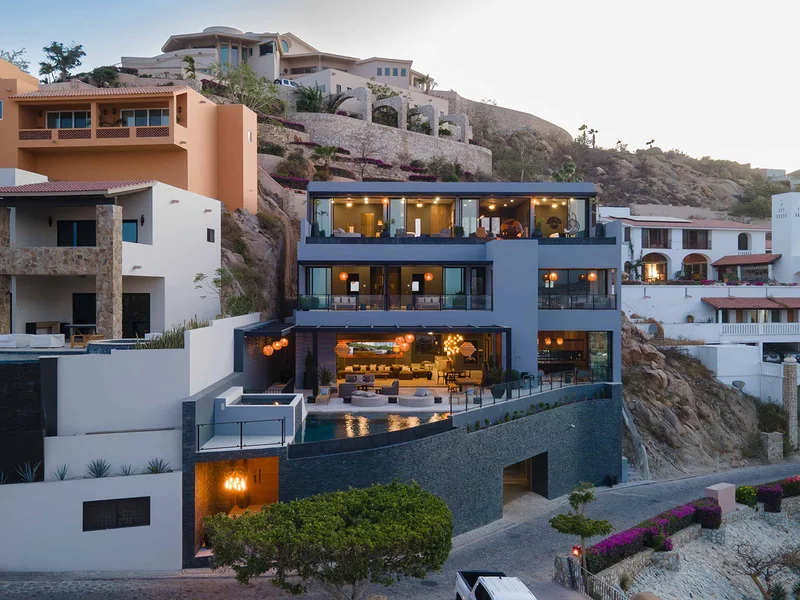
Saint-Tropez and its inland twin Ramatuelle form the first Riviera address for luxury villa travelers. The port itself is compact and photogenic but small (roughly 4,000 year-round residents), and the villa market lives above it on the hills of the Presqu'ile de Saint-Tropez: Ramatuelle village at 136 meters altitude with its bastides on the vineyards behind Pampelonne beach, Gassin (one of France's plus beaux villages) with views to the Massif des Maures, and the finger of Cap Camarat with private beach access. The beach-club economy (Club 55, La Reserve, Le Pinede, Loulou, Byblos) drives most of the July-August social calendar, and villa proximity to Pampelonne (5 to 12 minutes by car) is a real spec. Nice airport is 90 minutes east, Toulon-Hyeres 45 minutes west, and helicopter transfers from Nice to Saint-Tropez run 25 minutes at 3,000 to 5,000 euros. The tradeoff is congestion: the road in and out of the peninsula gridlocks nightly from mid-June, and a driver-included villa is not optional.
The Cannes-Antibes-Cap-Ferrat axis is the older-luxury coast and the tightest villa market in France. Cannes proper holds the Croisette hotel corridor and the villa stock behind it in La Californie and Super Cannes. Mougins and Mouans-Sartoux, ten minutes inland, hold the Provencal-style bastides that most Cannes Film Festival guests book at scale. Antibes, halfway between Cannes and Nice, holds the Cap d'Antibes peninsula where the Hotel du Cap-Eden-Roc sits alongside the private villa estates that share its coastline. Cap-Ferrat, twenty minutes east of Nice, is the highest-density luxury peninsula in France by land value: roughly 700 residents on 250 hectares, walking distance to Beaulieu-sur-Mer, ten minutes to Monaco. Villa La Leopolda and Villa Ephrussi de Rothschild sit here; the private estate market is thin but priced accordingly. Nice airport is 15 to 30 minutes to any of these three, the shortest airport-to-villa run on the coast.
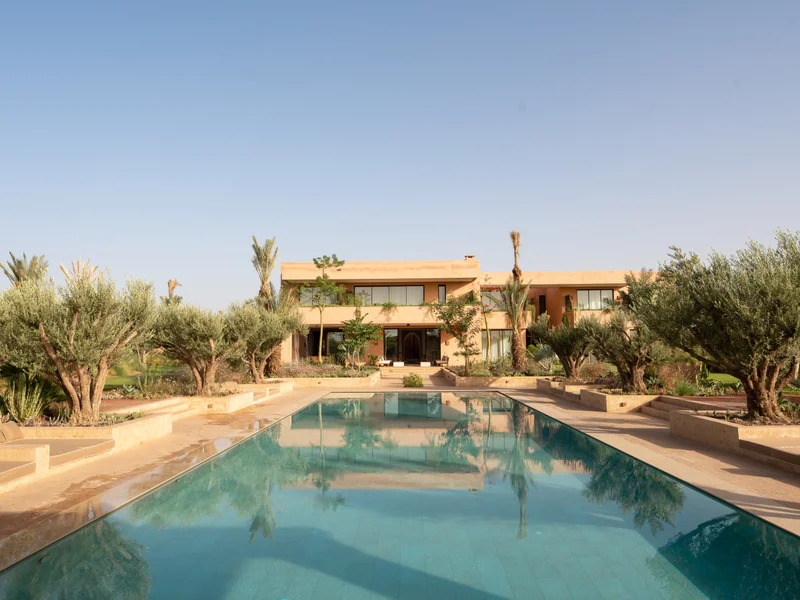
Provence, one hour inland from the coast, is a different product entirely. Aix-en-Provence, the university city Cezanne walked daily from his studio at Les Lauves, is the walkable-luxury base: the Cours Mirabeau, the daily food market at Place Richelme, restaurants (La Fromagerie du Passage, Restaurant Pierre Reboul, Mickael Feval), and villa stock on the Route de Cezanne, in the Ventabren hills, and in the vineyards south toward the Sainte-Victoire. The Luberon, forty-five minutes northeast, holds the bastide market that defined Provence in most travelers' imaginations: Gordes, Bonnieux, Menerbes, Roussillon, and Lourmarin, hilltop villages with restored stone farmhouses (mas) on three-to-fifteen-acre plots, private pools, olive groves, and a chef-and-housekeeper model that runs on the local Sunday-market economy. Marseille-Provence airport (MRS) is the closest airport at 30 minutes to Aix and 90 to the Luberon; Avignon TGV connects directly from Paris in 2 hours 40 minutes.
Paris is a neighborhood conversation, not a city one. The sixth arrondissement (Saint-Germain-des-Pres) is the walkable-cultural address: Rue de Seine galleries, Rue Bonaparte, the Latin Quarter cafes, five minutes to the Musee d'Orsay. The seventh (Faubourg Saint-Germain, Rue Cler, the Eiffel Tower quarter) is the residential-luxury address: hotel-particulier stock, ambassadorial residences, the Rodin museum, walking distance to the Champ de Mars. The eighth (Champs-Elysees, Golden Triangle, Rue du Faubourg Saint-Honore) is the shopping-and-palace-hotel address: the Bristol, the George V, the Plaza Athenee sit here, and the Faubourg Saint-Honore couture strip runs from the Elysee palace east. For families and longer stays, the sixteenth (Passy, Auteuil, Trocadero) and the seventh outperform the eighth on quiet and space per euro. Charles de Gaulle is 45 to 65 minutes to any of these depending on traffic; Orly is 25 to 40 minutes and better for southern connections.
The Alps split into three markets. Chamonix, at the foot of Mont Blanc in the Arve valley, is the mountaineering capital: raw altitude (Aiguille du Midi at 3,842 meters via the cable car), the Vallee Blanche off-piste run, and a working town that operates twelve months a year. Geneva airport is 65 minutes by car. Megeve, one valley north, is the family-luxury address: developed as a French answer to Saint-Moritz in the 1920s by the Rothschild family, walkable village center, more sun-terrace than steep-couloir, and the shortest ski-to-restaurant loop of the three. Courchevel 1850, in the Trois Vallees, is the premium price ceiling of French skiing: dense Michelin-star coverage across the valley, the shortest ski-in-ski-out chalet stock, and rates during Christmas-New Year that clear 15,000 to 40,000 euros a night for a fully staffed six-bedroom chalet. Val d'Isere holds the mid-luxury middle ground with better spring skiing than the others. Grenoble and Chambery airports service the Trois Vallees on winter charters as alternatives to Geneva.
Top villas in France
Beyond the villa gates
The Riviera beach-club day is the single strongest Cote d'Azur upgrade and the experience most first-time luxury travelers under-book. Club 55 on Pampelonne, opened in 1955 as a beach shack for the crew of Godard's Le Mepris and still owned by the same family, is the reference point: cabana rental, grilled fish, the anchor for a boat day that starts at Saint-Tropez harbor and ends at Palm Beach in Cannes. Le Pinede in Saint-Tropez, La Reserve in Ramatuelle, La Guerite on the Ile Sainte-Marguerite off Cannes, and Anjuna in Eze cover the rest of the coast. The pattern most guests settle into is one beach-club lunch every second day, arriving by tender off a chartered yacht, and villa dinner at home the other nights. Cabana and lounger reservations at the marquee clubs need 24 to 48 hours lead time in season; villa concierges hold the direct lines that outrun the aggregator apps.
The Provence chef-market circuit is the antidote and the counterprogramming. The Sunday market at Coustellet, the Tuesday at Gordes, the Friday at Lourmarin, and the Saturday at Apt are the anchor days, and a mas with a resident chef will build the week around them: a 7am walk with baskets, back for a courtyard breakfast of fig and yesterday's bread, lunch built from what came home. The truffle markets at Richerenches (Saturday, mid-November through mid-March) and Uzes reward a specific-week booking, and the lavender bloom at Sault and on the Valensole plateau runs from late June through mid-July, weather-dependent, with the picture-perfect window narrowing by year as climate shifts pull it earlier. Chateauneuf-du-Pape and the Rhone Valley wine estates run private tastings with 48 hours notice; a full-day driver at 400 to 600 euros makes the difference between three estates in a day and one.
Paris runs on a museum-and-gallery axis that rewards planning rather than walking. The Louvre requires timed entry and a strategy (Denon wing for the Italian Renaissance, Sully for the Egyptian, four hours minimum). The Musee d'Orsay is a shorter half-day and better for Impressionists at scale. The Fondation Louis Vuitton in the Bois de Boulogne, the Bourse de Commerce (the Pinault Collection, opened 2021), and the Palais de Tokyo hold the contemporary anchor. For collectors, the Rue de Seine gallery corridor in the sixth, and the Marais galleries in the third and fourth (Perrotin, Templon, Ropac), reward an afternoon walked with a private guide at 400 to 800 euros. Dinner reservations at the top tier (Le Bristol's Epicure, L'Ambroisie, Guy Savoy, L'Arpege, Alain Ducasse au Plaza Athenee) need three to six weeks notice; the Bouillon-style bistros (Bouillon Chartier, Bouillon Pigalle, Le Grand Colbert) walk in.
The Alps on-mountain product runs on the private-ski-instructor and altitude-restaurant model at the luxury tier. A private ESF (Ecole du Ski Francais) instructor runs 450 to 700 euros a day and unlocks the piste-priority queue at the marquee lifts, and every luxury chalet books one as a matter of course. Heli-skiing is prohibited by French regulation, so the heli day is a lift across to Zermatt or into Verbier where Swiss and Italian rules apply. Chef-driven mountain restaurants (La Folie Douce, La Bouitte at Saint-Martin-de-Belleville with three Michelin stars, La Table de l'Ours in Val d'Isere) are the lunch anchors. The apres-ski scene runs a short window from 4pm terrace crowds to 10pm restaurant transitions, and dinner reservations at the marquee altitude spots need 48 hours minimum in season.
Logistics + practicalities
The airport question depends on the region. Nice (NCE) is the primary Riviera hub, with direct service from every major European city and long-haul from New York, Dubai, Los Angeles, and Doha, 15 minutes to Cap-Ferrat, 30 to Cannes, 90 to Saint-Tropez by road (or 25 minutes by helicopter transfer at 3,000 to 5,000 euros). Paris runs on Charles de Gaulle (CDG) for long-haul and most European traffic, Orly (ORY) for southern European and North African routes and better for arrivals into the sixth and seventh arrondissements. Marseille (MRS) is the correct airport for Provence at 30 to 90 minutes to Aix and the Luberon, and the TGV from Paris runs Gare de Lyon to Aix-en-Provence TGV in 3 hours 10 minutes with taxis running the last five kilometers into town. The Alps use Geneva (GVA), a Swiss airport that sits 15 minutes from the French border, at 65 minutes to Chamonix, 90 to Megeve, 2 hours 15 to Courchevel; Grenoble and Lyon (LYS) are the domestic alternatives, and Chambery services Trois Vallees resorts on winter charter schedules.
Ground transport runs on private drivers plus rental cars, and the split depends on itinerary shape. Riviera guests who plan to stay on the coast and use the villa driver for beach-club days and Monaco dinners do not need a rental car; coastal traffic is punishing to unfamiliar drivers, and valet-only parking at the marquee restaurants adds friction. Provence guests do the opposite: the market-and-tasting circuit requires a car, and a self-drive rental from MRS is the correct default (Autoroute A7 and A9 to the Luberon, D roads to the villages). Paris runs on the Metro (a two-euro single ticket, a ten-euro all-day pass), taxis (G7 app, Uber, and Bolt operating without restriction), and the villa car for airport transfers only. In the Alps, ski-in-ski-out chalets remove the ground question during the trip; the transfer from Geneva is where the driver spend concentrates at 400 to 600 euros one-way for an eight-seat van in season. France runs on the euro; tipping is soft (5 to 10 percent on restaurant bills is generous, service compris typically included, 5 to 10 euros per driver, 100 to 200 euros end-of-stay envelope per villa staff member); tap water is potable everywhere and the carafe d'eau is a normal restaurant request; French is the working language and English competence has improved sharply in luxury venues over the last decade but a bonjour opens more doors than a hello. Schengen visa rules apply for non-EU travelers, and the 90-days-in-180 window catches out repeat American clients more than any other operating friction.
The lesson France taught me is that a France trip is really four trips, and the mistake I made twice before I stopped making it was quoting the Cote d'Azur to guests who wanted Provence. The first was a New York group who asked for a private villa week and I put them on the water in Saint-Tropez in August, and they spent the whole week complaining about the road in and out of the peninsula. The second was a London couple who asked for slow luxury and I sent them to Cap-Ferrat, right neighborhood wrong season, and the beach clubs were too loud for what they actually wanted. Now I ask two questions before any France quote: is the trip about the water or the market, and is it about the event or the quiet. The answers point to the region every time.
Cameron Elder, ERentals Exclusive
Frequently asked
What is the best region in France for a luxury villa?
It depends on the trip. The Cote d'Azur (Saint-Tropez, Cannes, Antibes, Cap-Ferrat) is correct for coastal trips built around beach clubs, yacht charter, and event weekends like Cannes and the Monaco Grand Prix. Provence (Aix, the Luberon) is correct for slow weeks built around markets, chef service, and the vineyard-and-village circuit, with the villa as anchor rather than the beach. Paris is correct for cultural weeks and city luxury, booked into the sixth, seventh, or eighth arrondissement. The Alps are correct for the December-through-April ski season, with Courchevel 1850, Megeve, Chamonix, and Val d'Isere the primary chalet markets. First-time luxury France travelers most often book the Cote d'Azur; repeat travelers rotate through the four.
Do luxury villas in France include a private chef?
Provence bastides and Alpine chalets typically include chef service in the nightly rate, matching the household-with-staff tradition native to both regions. Cote d'Azur villas vary more: the top-tier estates on Cap-Ferrat and above Saint-Tropez include a full household (chef, housekeeper, butler, driver), and mid-tier villas offer chef service as an add-on at 400 to 800 euros per day plus provisioning. Paris apartments most often provide a housekeeper by default and book chefs a la carte at 250 to 500 euros per dinner plus market. The French chef standard is regional (Nicoise seafood on the coast, Provencal cuisine du terroir inland, Savoie-style raclette and tartiflette in the Alps, technique-driven cooking in Paris), and any villa concierge can arrange a chef within 48 hours notice.
How many nights should I stay in France?
Seven nights is the standard first-trip window for any one region, and ten to fourteen nights is the pattern for travelers combining two regions (Provence plus Paris, or Cote d'Azur plus the Alps in winter). Cannes Film Festival, Monaco Grand Prix, and Christmas-New Year require seven-night minimums as a matter of villa policy; February half-term in the Alps typically requires seven; Provence in low season accepts three-to-five-night stays. Paris apartments accept shorter stays but the sixth-seventh-eighth luxury tier typically holds a three-night minimum with the top apartments moving to seven for peak windows. For repeat travelers who know a region, four-night long weekends work particularly well in Provence and Paris.
Is France good for families with children?
The Cote d'Azur and Provence are the strongest family regions, with pool-first villas in Ramatuelle, Mougins, Bonnieux, and Lourmarin the anchor. Beach-club families do well on the Cap-Ferrat and Antibes coast where the water is calmer than at Pampelonne. Paris works for families with older children but the apartment-versus-townhouse tradeoff (stairs, no yard, elevator queues) is a real friction below age seven. Alpine chalets are family-strong from December through April with ski-school programs starting at age three at every major resort, and Megeve is the most family-oriented of the four premium chalet markets. Villas can arrange nannies with 48 hours notice at 25 to 40 euros per hour across all four regions.
Do I need a car in France?
In Provence, yes: the market-and-village circuit is a car-based itinerary and rental cars from Marseille airport are the standard default. On the Cote d'Azur, no: the coast is congested, coastal parking is punishing, and villa drivers at 400 to 800 euros a day are cheaper than the parking-and-valet penalty at every marquee restaurant. In Paris, no: the Metro is fast and taxis are plentiful. In the Alps, only for the Geneva transfer, and even that is better booked as a private driver: French Alpine driving in winter is unforgiving to travelers on summer tires or unfamiliar with hairpin routes to altitude.
When is the best time of year to visit France?
For the Cote d'Azur, June and September are the highest-value windows: warm enough for the water, thinner on the road than July and August, priced below the Cannes and Monaco spikes. For Provence, May and September are the strongest weather-and-quiet combination in the country, with the Luberon lavender bloom late June through mid-July as the peak-photo window. Paris is a year-round product with the two fashion weeks (late February, late September) and Roland-Garros (late May, early June) as the demand spikes to avoid or plan around, and August as the true local-quiet window. For the Alps, February for the deepest snow at Courchevel and Val d'Isere, April for the value shoulder with terrace-warm days and altitude snow still holding.