Puerto Vallarta Humpback Charters

Private yacht charters in Banderas Bay for the December to March humpback season. How the season works, what the Marietas rules actually allow, and the boats we recommend by group size.

Every northern winter the humpbacks come to Banderas Bay. They travel down from the cold feeding grounds of the north Pacific to breed and to calve in warm sheltered water, and Banderas is one of the places they choose: a deep, wide bay protected by headlands at both ends, which is exactly the shape a mother whale wants for a calf. The season commonly runs from around December through March, and for those months the bay in front of Puerto Vallarta is one of the better places in the Pacific to be on a boat. Most visitors experience that from a shared tour: ninety people, two hours, a fixed route and a public address system. A private charter is a different day entirely. You leave when the light is good rather than when the schedule says, you stay with an animal if it is doing something interesting, you eat properly, and you spend the rest of the day at Yelapa or Las Caletas or anchored somewhere quiet rather than being returned to a dock at noon. For a family or a group of friends, the gap between those two days is very large. The five boats in this collection run from a forty-seven foot catamaran for sixteen to a ninety foot motor yacht that takes fifty. Every one carries snorkel gear, paddle boards and a lily pad, most carry fishing gear, and the larger ones carry a private chef and a full bar. What follows is how the season actually works, what the Marietas rules allow, and which boat fits which group.

How the humpback season works

The humpbacks arrive in Banderas Bay across the northern winter, and the season is commonly given as roughly December to March. They are here to breed and to give birth, which is why the behaviour is so visible: this is not a feeding ground where animals spend their time below the surface, it is a breeding ground where males compete and mothers stay near the top with calves. Breaching, pectoral slapping and tail lobbing are what people come for, and January and February are usually the fullest weeks of the season. Mexican whale watching runs under season rules and licensed operators, and we book licensed captains only. The rules govern how close a boat may approach, how many boats may be near an animal and how they must behave around mothers with calves. That matters for the whales, and it also produces the better day: a captain working properly positions the boat and lets the animals come, which is how you get the encounters people remember rather than a chase. We do not promise sightings, and we would be suspicious of anyone who does. In peak season on a full-day private charter your odds are good, and they are considerably better than on a two-hour shared trip, because you have the time to go where the reports are and the flexibility to wait. What we will promise is that the day is worth taking whether or not a whale surfaces next to the boat, which is the honest reason to build it around a charter rather than a tour ticket.

What else the bay gives you in the same day

Banderas Bay is large and the good anchorages are spread around its southern shore, which is why a full day beats a morning. Yelapa is a village at the south end with no road in, reached by boat, with a waterfall walk behind it and palapa restaurants on the sand. Las Animas and Quimixto are the smaller coves on the same stretch. Las Caletas sits further along, a beach that was once a private retreat and is now the classic day-trip anchorage. Any of these turns the back half of a whale day into the reason people book the boat again next year. The Marietas Islands are the other draw and they need explaining honestly. The islands are a protected national park and the famous Playa del Amor, the hidden beach inside a collapsed crater, is access-controlled: there is a daily visitor cap, permits are required, and access is restricted to protect a site that was being damaged by volume. That is a constraint to plan around, not a detail. We will tell you what is possible on your dates and we will not imply we can simply take a group of twenty ashore because the photograph exists. Snorkelling and diving around the islands is often the better and more reliable version of that trip. For groups who want the water rather than the itinerary, every boat here carries snorkel gear, paddle boards and a lily pad, and most carry fishing gear. Banderas Bay fishes well, and a morning with the whales and an afternoon with the rods is a common and very good combination. The boats with multiple sun decks make the difference on a full day, because a group of twenty needs somewhere to spread out.

Matching the boat to the group

Catamarans and motor yachts behave differently and the choice is not only about headcount. A catamaran is stable, shallow-drafted and social: wide trampolines at the bow, very little roll at anchor, and a layout that keeps everyone together. It suits families with children and anyone who is uneasy about seasickness. A motor yacht is faster, drier in a chop, and has more interior: a saloon to retreat into, proper cabins, and more shade. It suits longer days, larger groups and anyone who wants to cover more of the bay. Catering is the other axis. The Pajot 47 carries a private chef, an onboard mixologist and a premium open bar. The Hatteras 122 carries white-glove service, a private chef and a premium open bar. The Cheoy Lee 90 carries a standard open bar with two lounging levels and a spacious saloon and dining area. The Azimut 85 carries a hot tub and a water slide, which on a family day is worth more than any other single feature on this page. The Marquis 50 carries light appetizers and a choice of premium bottles. Where a boat offers chef service or a bar upgrade as an add-on, we will price it for you before you commit rather than leaving it to the day. Our general advice for a whale day is to take more boat than the headcount strictly requires. A full day in open water with sixteen people on a boat rated for sixteen is a different experience from the same sixteen on a
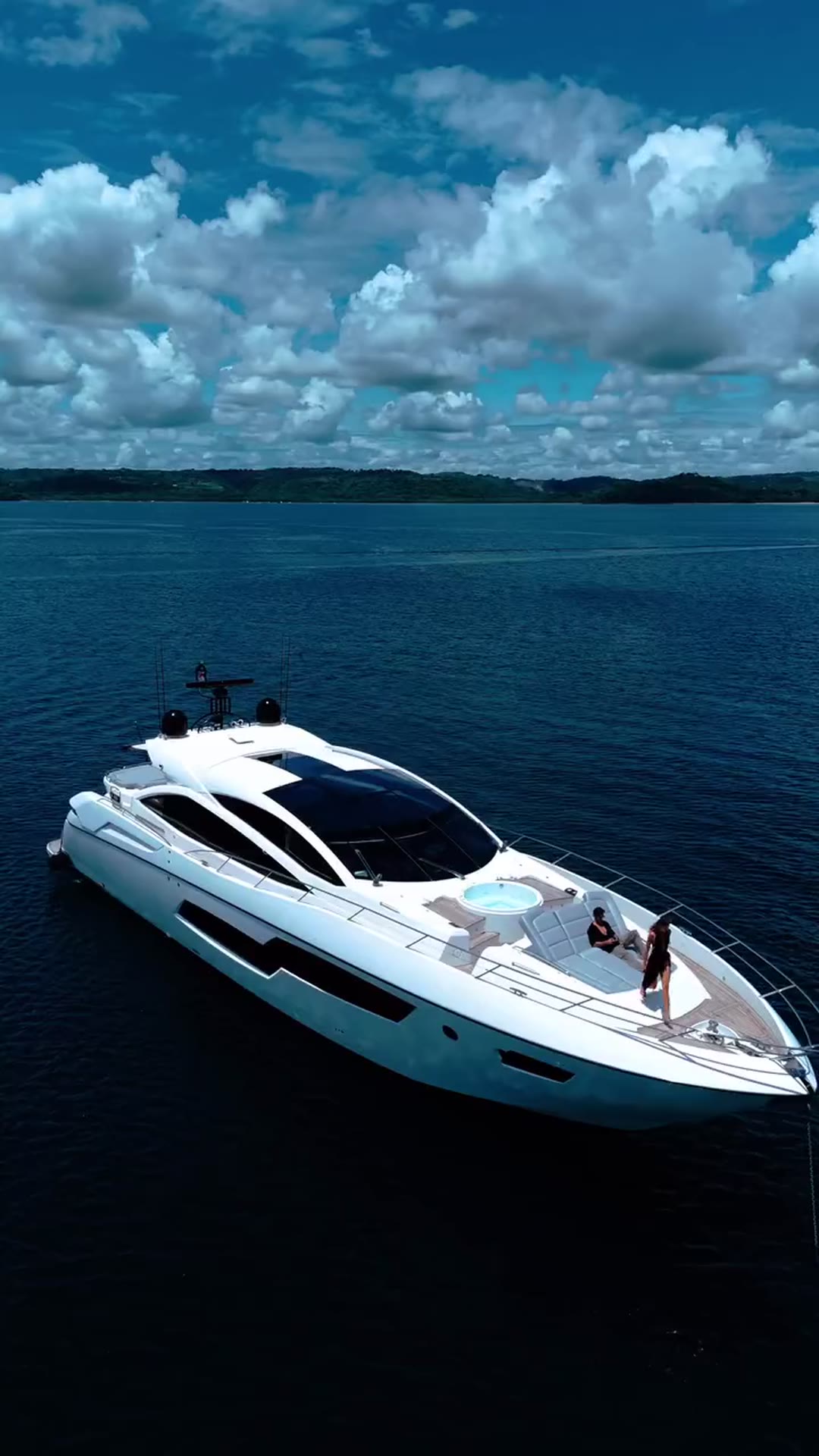
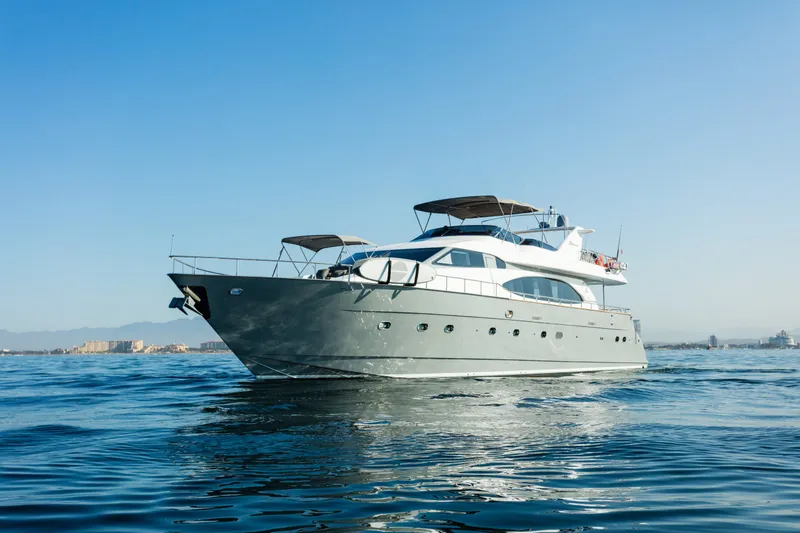
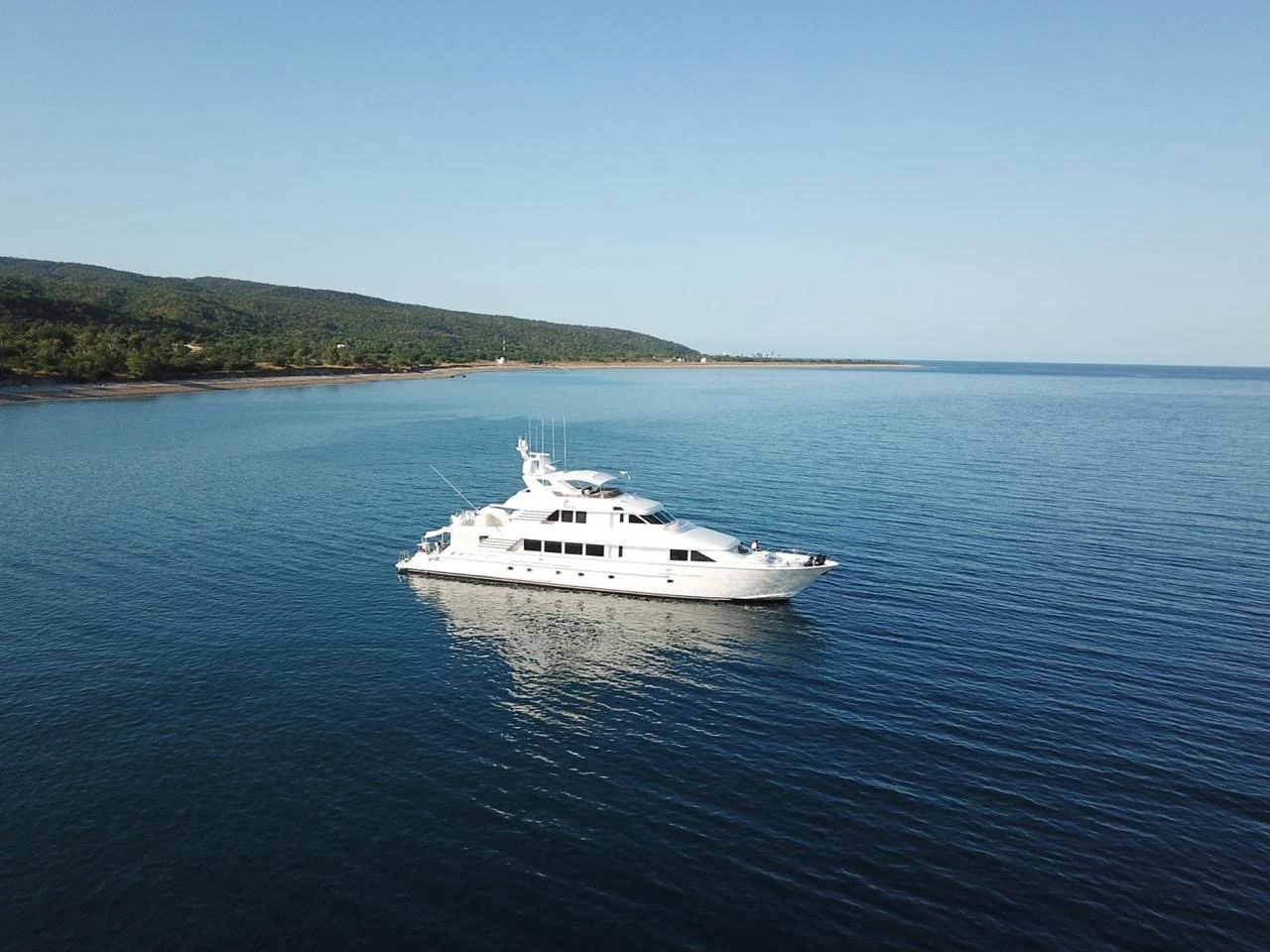
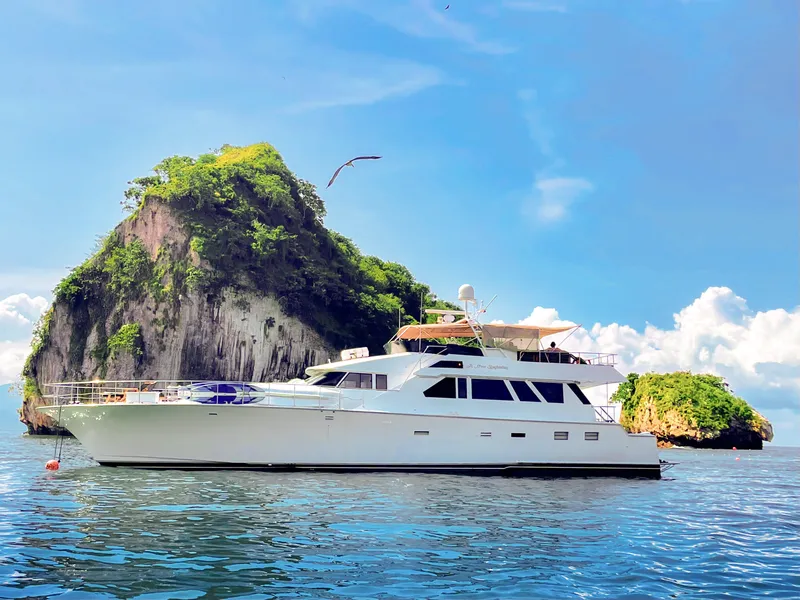
A private motor yacht anchored in Banderas Bay, Puerto Vallarta
Banderas Bay Humpback Season

The winter the whales come to calve

December to March. 5 private charters in Puerto Vallarta.
The season, from a private home

Every northern winter the humpbacks come to Banderas Bay.

They travel down from the cold feeding grounds of the north Pacific to breed and to calve in warm sheltered water, and Banderas is one of the places they choose: a deep, wide bay protected by headlands at both ends, which is exactly the shape a mother whale wants for a calf. The season commonly runs from around December through March, and for those months the bay in front of Puerto Vallarta is one of the better places in the Pacific to be on a boat. Most visitors experience that from a shared tour: ninety people, two hours, a fixed route and a public address system.
5
Charters in Banderas Bay
50
Guests at capacity
50
Guests on the largest boat
No sighting promised
Licensed captains only
Mexican whale watching runs under season rules. A captain working properly lets the animals come rather than chasing them.
Take the full day
The bay is the other half
Yelapa, Las Animas, Las Caletas. The hours after the whales are why people book the boat again next year.
Marietas is capped
Permits, not photographs
The hidden beach has a daily visitor cap and permit control. We tell you what is possible on your dates.
A private charter is a different day entirely. You leave when the light is good rather than when the schedule says, you stay with an animal if it is doing something interesting, you eat properly, and you spend the rest of the day at Yelapa or Las Caletas or anchored somewhere quiet rather than being returned to a dock at noon. For a family or a group of friends, the gap between those two days is very large. The five boats in this collection run from a forty-seven foot catamaran for sixteen to a ninety foot motor yacht that takes fifty.
Every one carries snorkel gear, paddle boards and a lily pad, most carry fishing gear, and the larger ones carry a private chef and a full bar. What follows is how the season actually works, what the Marietas rules allow, and which boat fits which group.
How the humpback season works
The humpbacks arrive in Banderas Bay across the northern winter, and the season is commonly given as roughly December to March. They are here to breed and to give birth, which is why the behaviour is so visible: this is not a feeding ground where animals spend their time below the surface, it is a breeding ground where males compete and mothers stay near the top with calves. Breaching, pectoral slapping and tail lobbing are what people come for, and January and February are usually the fullest weeks of the season.
Mexican whale watching runs under season rules and licensed operators, and we book licensed captains only. The rules govern how close a boat may approach, how many boats may be near an animal and how they must behave around mothers with calves. That matters for the whales, and it also produces the better day: a captain working properly positions the boat and lets the animals come, which is how you get the encounters people remember rather than a chase.
We do not promise sightings, and we would be suspicious of anyone who does. In peak season on a full-day private charter your odds are good, and they are considerably better than on a two-hour shared trip, because you have the time to go where the reports are and the flexibility to wait. What we will promise is that the day is worth taking whether or not a whale surfaces next to the boat, which is the honest reason to build it around a charter rather than a tour ticket.
What else the bay gives you in the same day
Banderas Bay is large and the good anchorages are spread around its southern shore, which is why a full day beats a morning. Yelapa is a village at the south end with no road in, reached by boat, with a waterfall walk behind it and palapa restaurants on the sand. Las Animas and Quimixto are the smaller coves on the same stretch. Las Caletas sits further along, a beach that was once a private retreat and is now the classic day-trip anchorage. Any of these turns the back half of a whale day into the reason people book the boat again next year.
The Marietas Islands are the other draw and they need explaining honestly. The islands are a protected national park and the famous Playa del Amor, the hidden beach inside a collapsed crater, is access-controlled: there is a daily visitor cap, permits are required, and access is restricted to protect a site that was being damaged by volume. That is a constraint to plan around, not a detail. We will tell you what is possible on your dates and we will not imply we can simply take a group of twenty ashore because the photograph exists. Snorkelling and diving around the islands is often the better and more reliable version of that trip.
For groups who want the water rather than the itinerary, every boat here carries snorkel gear, paddle boards and a lily pad, and most carry fishing gear. Banderas Bay fishes well, and a morning with the whales and an afternoon with the rods is a common and very good combination. The boats with multiple sun decks make the difference on a full day, because a group of twenty needs somewhere to spread out.
Matching the boat to the group
Catamarans and motor yachts behave differently and the choice is not only about headcount. A catamaran is stable, shallow-drafted and social: wide trampolines at the bow, very little roll at anchor, and a layout that keeps everyone together. It suits families with children and anyone who is uneasy about seasickness. A motor yacht is faster, drier in a chop, and has more interior: a saloon to retreat into, proper cabins, and more shade. It suits longer days, larger groups and anyone who wants to cover more of the bay.
Catering is the other axis. The Pajot 47 carries a private chef, an onboard mixologist and a premium open bar. The Hatteras 122 carries white-glove service, a private chef and a premium open bar. The Cheoy Lee 90 carries a standard open bar with two lounging levels and a spacious saloon and dining area. The Azimut 85 carries a hot tub and a water slide, which on a family day is worth more than any other single feature on this page. The Marquis 50 carries light appetizers and a choice of premium bottles. Where a boat offers chef service or a bar upgrade as an add-on, we will price it for you before you commit rather than leaving it to the day.
Our general advice for a whale day is to take more boat than the headcount strictly requires. A full day in open water with sixteen people on a boat rated for sixteen is a different experience from the same sixteen on a boat rated for twenty-five. Shade, seating and somewhere to be away from the group all matter more at hour six than they do at hour one.
Choosing the right charter
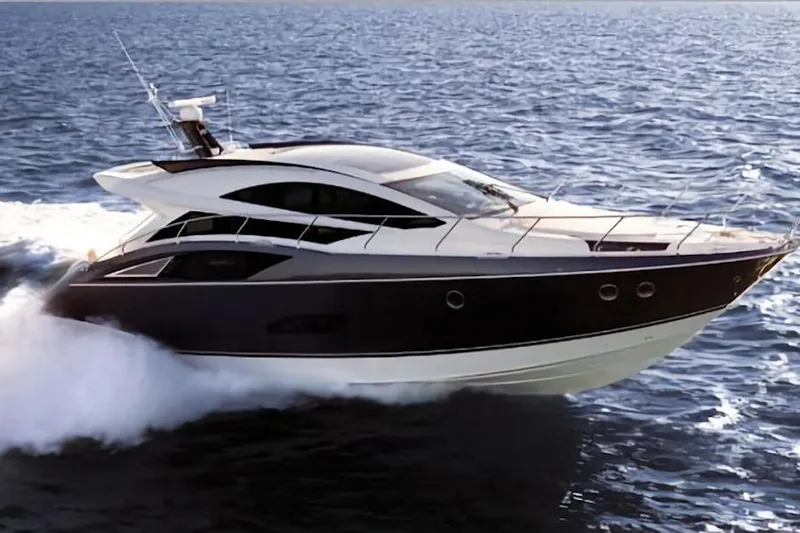
For up to twelve, the Marquis 50 is the straightforward choice: bow sun pads, snorkel gear, a paddle board, light appetizers and a choice of premium bottles, with chef service available as an add-on. It is the right size for a family or two couples who want the bay without a crew of twenty around them.
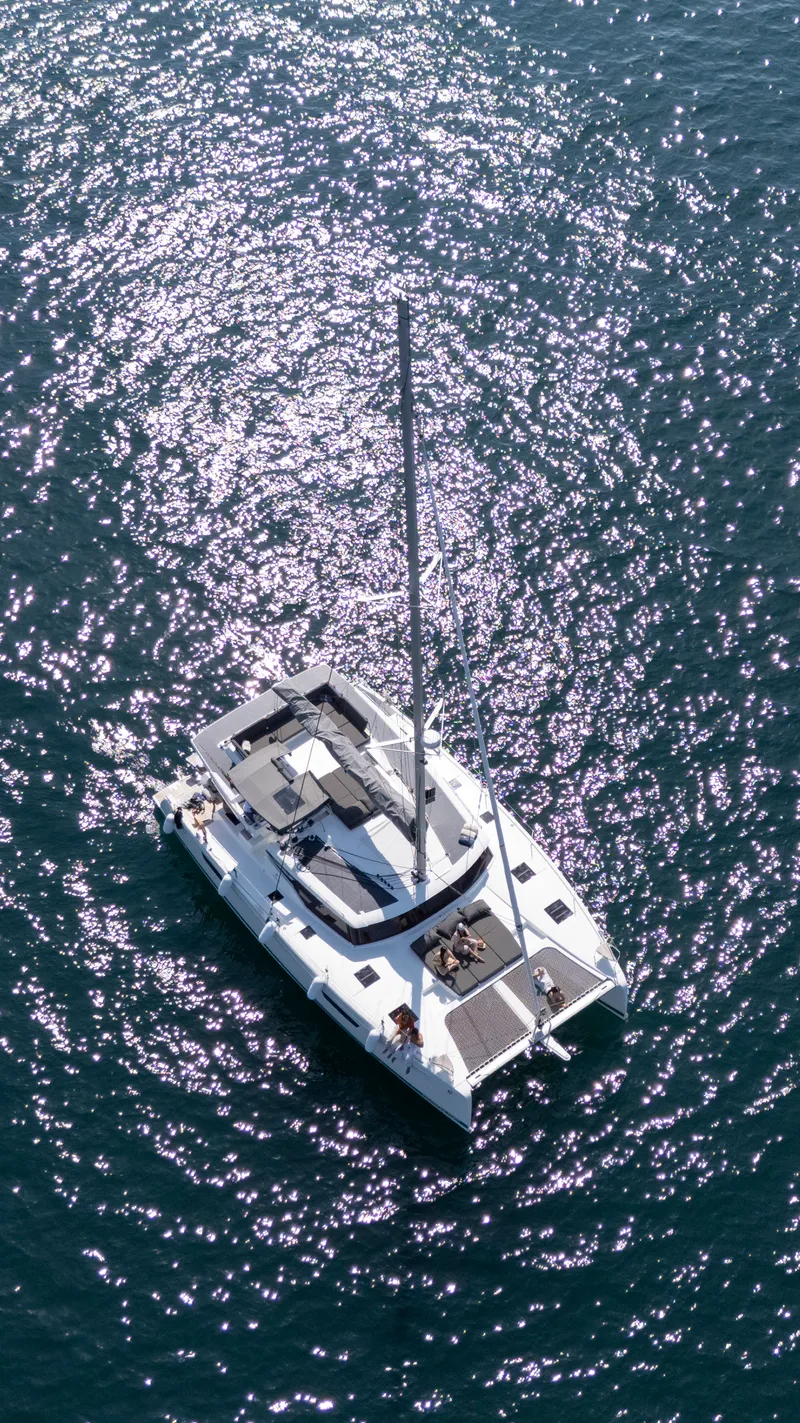
For up to sixteen, the Pajot 47 is the boat we suggest most often for whale season. It is a catamaran, so it is stable at anchor and forgiving for anyone prone to seasickness, and it carries a private chef, an onboard mixologist, a premium open bar, snorkel gear, paddle boards, fishing rods, a lily pad and dinghy access to remote beaches. That dinghy matters: it is what gets a small group onto a beach a larger boat cannot reach.
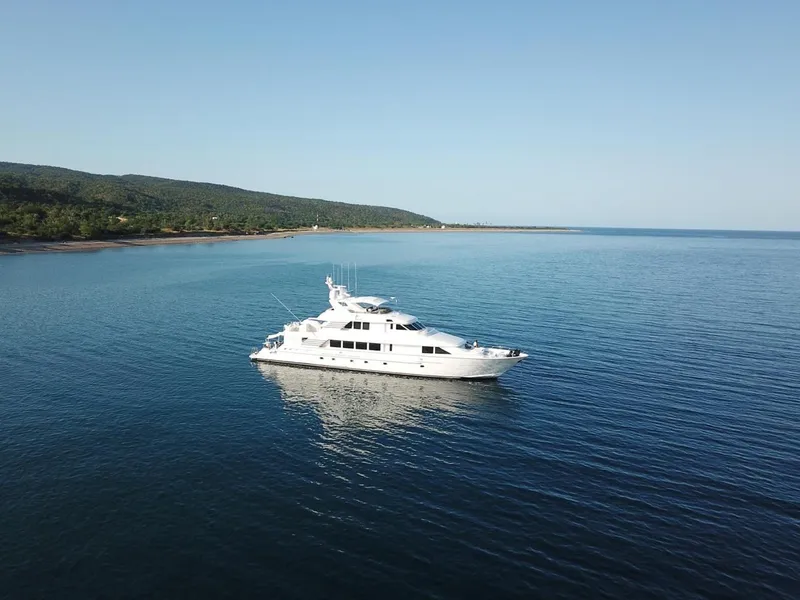
For larger groups, three boats scale up. The Hatteras 122 takes twenty-two with white-glove service, a private chef, a premium open bar, multiple sunbathing decks and a full saloon, and it is the most comfortable long day on the roster. The Azimut 85 takes twenty-five and carries a hot tub, a water slide, multiple sun decks, two paddle boards, fishing rods and a lily pad, which makes it the family boat. The Cheoy Lee 90 takes fifty across two lounging levels with a spacious saloon and dining, a standard open bar, snorkel gear, two paddle boards, fishing gear and a lily pad, and it is the one for a celebration rather than a quiet whale morning.
Where we would place you
47' Pajot Catamaran
A forty-seven foot catamaran for sixteen with a private chef, onboard mixologist, premium open bar, snorkel gear, paddle boards, fishing rods, a lily pad and dinghy access to remote beaches. Stable at anchor, which is why we suggest it first for whale season and for anyone prone to seasickness.
sleeps 16 | From $5,000 USD per charter
Puerto Vallarta, Mexico
122' Hatteras
A hundred and twenty-two foot motor yacht for twenty-two with white-glove service, a private chef, a premium open bar, multiple sunbathing decks and a full saloon. The most comfortable full day on the roster.
sleeps 22 | From $20,400 USD per charter
Puerto Vallarta, Mexico
85' Azimut Don Moi
An eighty-five foot motor yacht for twenty-five with a hot tub, a water slide, multiple sun decks, two paddle boards, fishing rods and a lily pad. The family boat, and the water slide is worth more on a long day than any other single feature here.
sleeps 25 | From $11,400 USD per charter
Puerto Vallarta, Mexico
90' Cheoy Lee
A ninety foot motor yacht for fifty across two lounging levels, with a spacious saloon and dining, a standard open bar, snorkel gear, two paddle boards, fishing gear and a lily pad. The boat for a celebration rather than a quiet whale morning.
sleeps 50 | From $6,150 USD per charter
Puerto Vallarta, Mexico
50' Marquis 500
A fifty foot motor yacht for twelve with bow sun pads, snorkel gear and a paddle board, light appetizers and a choice of premium bottles, with chef service available as an add-on. The right size for a family or two couples.
sleeps 12 | From $5,050 USD per charter
Puerto Vallarta, Mexico
, ERentals Exclusive
Frequently asked
When is humpback season in Puerto Vallarta?
The humpbacks are in Banderas Bay across the northern winter, with the season commonly running from around December through March. January and February are usually the fullest weeks. They come to breed and to calve, which is why the surface behaviour is so visible: this is a breeding ground, not a feeding ground.
Will we definitely see whales?
No, and be suspicious of anyone who promises it. In peak season on a full-day private charter the odds are good and considerably better than on a two-hour shared trip, because you have the time to go where the reports are and the flexibility to wait. What we will say is that the day is worth taking whether or not a whale surfaces beside the boat.
Why a private charter instead of a shared whale tour?
A shared tour is around ninety people, two hours, a fixed route and a public address system. A private charter leaves when the light is good, stays with an animal that is doing something interesting, feeds you properly, and spends the rest of the day at Yelapa or Las Caletas rather than returning you to a dock at noon. For a family or a group of friends the gap between those two days is very large.
Can we go to the hidden beach at the Marietas Islands?
Sometimes, and it needs planning rather than assuming. The Marietas are a protected national park and Playa del Amor has a daily visitor cap with permits required, put in place because volume was damaging the site. We will tell you what is possible on your dates and we will not imply we can land a group of twenty because the photograph exists. Snorkelling and diving around the islands is often the better and more reliable version of that trip.
Catamaran or motor yacht?
A catamaran is stable, shallow-drafted and social, with very little roll at anchor, which suits families with children and anyone uneasy about seasickness. A motor yacht is faster, drier in a chop and has more interior to retreat into, which suits longer days and larger groups. For a whale day with a mixed-age group, we usually suggest the catamaran.
What size boat do we need?
More than the headcount strictly requires. A full day in open water with sixteen people on a boat rated for sixteen is a different experience from the same sixteen on a boat rated for twenty-five. Shade, seating and somewhere to be away from the group all matter far more at hour six than at hour one.

What else is worth doing in the bay on the same day?
Yelapa, a village at the south end with no road in, reached only by boat, with a waterfall walk and palapa restaurants on the sand. Las Animas and Quimixto are the smaller coves on the same stretch. Las Caletas is the classic day anchorage further along. Any of these turns the back half of a whale day into the reason people book the boat again the next year.
Is food and drink included?
It varies by boat and we list it per charter rather than promising it across the fleet. Some carry a private chef and a premium open bar as standard, others carry appetizers and a bottle selection with chef service as an add-on. Where something is an add-on we price it for you before you commit rather than leaving it to the day.
Can we fish as well?
Yes. Banderas Bay fishes well and most of these boats carry fishing gear. A morning with the whales and an afternoon with the rods is a common combination and a very good one, particularly for a group where not everyone is equally interested in watching for spouts.
The collection
Browse 5 Vallarta charters
Filter by guest count

Plan a whale day in Banderas Bay

Tell us your dates, your group size and whether anyone gets seasick. We will match the boat.
Name *
Email *
Phone
Number of Guests
Message (optional)
Share your dates and group size. We reply within 2 hours.
Stay in the loop
© 2026 ERentals Exclusive